Conference Lead Gen in 2026: The Full Guide to Automated Outreach & Attendee Lists
Here's something that will make you feel slightly ridiculous once you hear it.
Every single conference you've ever attended - or even thought about attending - publishes some version of a participants page, speakers page, sponsors list, or attendee directory. It's right there. On the website. In public. A curated, intent-rich lead database that practically nobody is systematically working.
Sales teams spend $30,000 on a booth. Marketing teams spend weeks designing collateral. RevOps builds elaborate lead-scoring models. And meanwhile, there's a free, structured list of exactly the right people - organized by company, title, and industry - sitting on a webpage that everyone scrolls past because it feels too obvious to be a strategy.
This is literally the most underrated growth hack in B2B. And in this full guide, we're going to break down exactly how to turn conference attendee lists into a repeatable, automated outreach machine that fills your pipeline.
Why Conference Lead Gen Is the Highest-ROI Channel Nobody Talks About
Let's start with the economics.
According to Bizzabo's 2025 Event Industry Report, 79% of B2B marketers rank in-person events as their single most effective channel for pipeline generation. Forrester's data shows that event-sourced leads convert to opportunities at 2–3x the rate of leads from paid digital channels.
But here's the paradox: most teams measure event ROI by counting badge scans at their booth. That captures maybe 5–10% of the relevant attendees at any given conference.
The other 90%? They walked right past your booth, attended a different session, or were in the hallway having a coffee. Their names and companies are still on the attendee list.
The Attendee List Advantage
What makes a conference attendee list fundamentally different from a cold prospecting list?
Factor | Cold Prospect List | Conference Attendee List |
|---|---|---|
Intent signal | None or inferred | High - they registered for a relevant industry event |
Recency | Varies | Real-time - the event is happening now or soon |
Topical relevance | You chose the filter | They self-selected into your market's conversation |
Shared context | None | The conference itself - a natural conversation starter |
Data quality | Decays ~30% annually | Fresh, often verified by event organizers |
Cost per lead | $50–$200+ (paid databases) | Effectively $0 |
The key insight: conference attendees are pre-qualified by interest, industry, and timing. They've raised their hand by registering. That makes them warmer than almost any outbound list you could buy.
The Anatomy of a Conference Attendee Page (And Why It's a Goldmine)
Not all attendee pages are created equal, but most major B2B conferences publish at least some combination of the following:
Speakers page - Names, titles, companies, bios, headshots, sometimes LinkedIn URLs
Sponsors/exhibitors page - Company names, booth info, sometimes key contacts
Attendee directory - Varies by event; some require login, others are fully public
Agenda/session pages - Panelists, moderators, workshop leaders with full bios
Networking platform profiles - Many events use Brella, Grip, Swapcard, or similar platforms that list registered attendees
Each of these is a structured data source. Speakers and sponsors are especially valuable because they're typically decision-makers - VPs, C-suite, founders - who are investing time and money to be visible at the event.
What Data You Can Typically Extract
From a single conference website, you can usually collect:
Full name
Job title
Company name
Company website (from sponsor/exhibitor pages)
Bio or description (useful for personalization)
Session topic (tells you exactly what they care about)
Social links (LinkedIn, Twitter/X)
Headshot (confirms identity for LinkedIn matching)
That's more context than most sales intelligence platforms give you - and it's sitting on a public webpage.
Step-by-Step: How to Build a Conference Lead Gen System
Let's move from theory to execution. Here's the exact playbook for turning conference attendee lists into pipeline.
Step 1: Identify the Right Conferences
Not every event deserves your attention. Focus on conferences where your ideal customer profile (ICP) concentrates.
Build a conference calendar using these criteria:
Industry alignment - Is this event in your target vertical?
Attendee seniority - Are decision-makers present, or is it mostly junior practitioners?
Size - Events with 500–5,000 attendees often hit the sweet spot (large enough to matter, small enough to be personal)
Content theme - Does the conference agenda overlap with the problems your product solves?
Geographic relevance - Especially important for companies with regional sales teams
Pro tip: You don't need to attend the conference to work the attendee list. Some of the highest-performing conference lead gen campaigns are run by teams who never set foot in the venue.
Step 2: Collect and Structure the Attendee Data
This is where most people stop - because manually copying names from a website feels tedious. It is tedious. That's why automation matters.
There are several approaches:
Manual collection (small events):
Visit the speakers, sponsors, and attendee pages
Copy data into a spreadsheet
Enrich with LinkedIn profile URLs and email addresses using tools like Apollo, Hunter, or Clearbit
Semi-automated collection (mid-size events):
Use browser extensions or simple scraping tools to pull structured data from event pages
Clean and deduplicate in a spreadsheet or CRM
Enrich programmatically via API-connected tools
Fully automated collection (at scale):
This is where purpose-built tools like Conference Hero come in. Instead of manually hunting across dozens of conference websites, Conference Hero monitors event attendee pages, extracts structured lead data, and delivers enriched, ready-to-work contact lists directly to your workflow. It turns what used to be hours of manual research into a hands-off system.
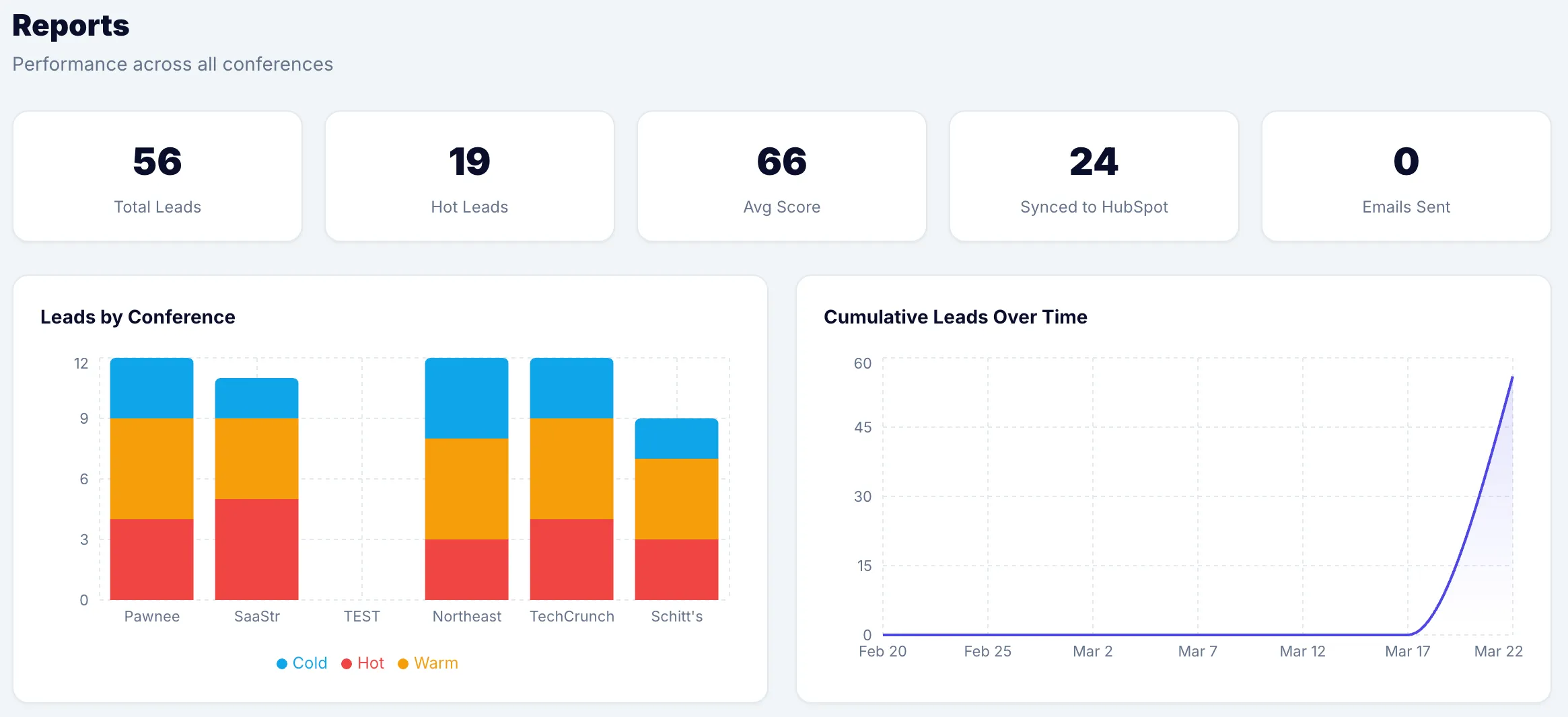
Regardless of your method, the goal is the same: a clean, enriched list with name, title, company, email, LinkedIn URL, and conference context.
Step 3: Segment and Prioritize
Not every attendee deserves the same outreach. Segment your conference attendee list before you write a single message.
Tier 1 - High priority: Speakers, panelists, and sponsors who match your ICP. These are decision-makers who are publicly investing in the event. They're visible, engaged, and likely open to relevant conversations.
Tier 2 - Medium priority: Attendees whose title and company match your ICP but who aren't speaking or sponsoring. Still high-intent (they registered), but you have slightly less context for personalization.
Tier 3 - Lower priority (but still valuable): Attendees in adjacent roles or industries. Good for nurture sequences or broader awareness campaigns.
Segment by timing too:
Pre-event (2–4 weeks before): "I saw you're speaking at [Conference] - would love to connect"
During event (day of): "Are you at [Conference] right now? I'd love to grab 15 minutes"
Post-event (1–5 days after): "How was [Conference]? I caught [Speaker]'s talk on [Topic] and thought of you"
Step 4: Craft Personalized, Context-Rich Outreach
Here's where conference lead gen separates itself from generic outbound.
You're not cold emailing a stranger. You're reaching out to someone with a shared context - the conference. That shared context is your personalization lever, and it dramatically changes the psychology of the interaction.
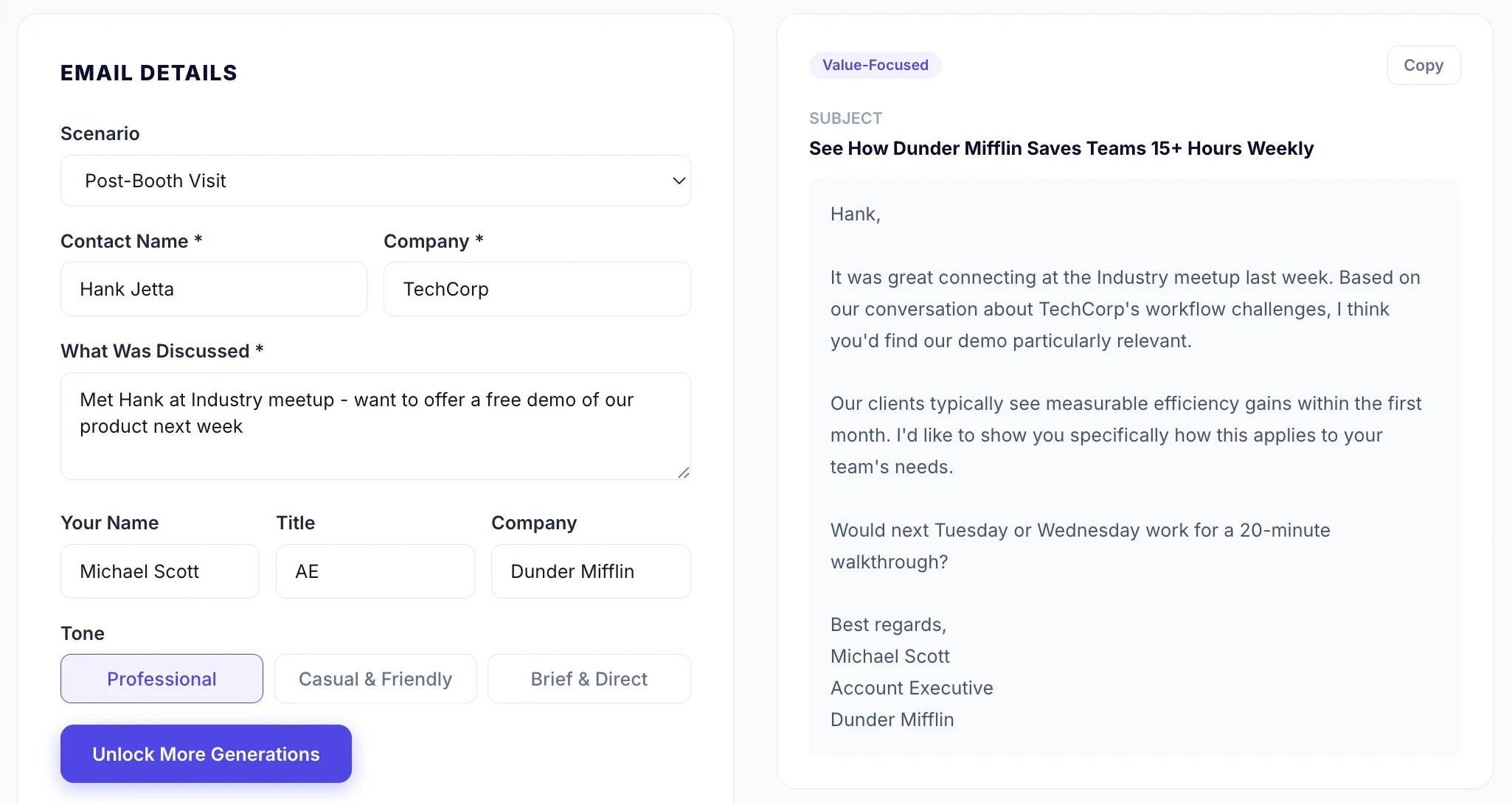
Use our Free tool to generate amazing email follow-ups: